
-05cede0b.png)
If you go to a beach in Lombok—or almost anywhere in Indonesia—you are likely to be told that it is beautiful. And it often is. The water can be clear, the sand pale and soft, the horizon wide and generous. But if you look down for long enough, you will also find something else: a bottle cap half-buried near the tide line, a torn plastic wrapper tangled in seaweed, a fragment of foam smoothed by waves. The trash is never hard to find. It may be impossible to eliminate entirely, but its presence is undeniable, woven into even the most postcard-ready shores.
According to a study, Indonesia generates 3.2 million tons of plastic waste each year, much of which ends up in the ocean, disrupting marine ecosystems, endangering wildlife, and damaging the coastlines that sustain local communities.
The Indonesia Biru Foundation (IBF) began its work quietly, along the coasts of West Nusa Tenggara, where damaged reefs and poor waste management have become ordinary features of daily life. Its director, Raditya Andrean Saputra, has been working there since 2020, building conservation programs that local communities actually use.
Along the Shore
-0719021a.jpg)
As long as people continue to dispose of waste carelessly, without any real sense of responsibility, or no government involvement, meaningful change remains difficult. This is the reality Andre continues to see. The obstacles, he said, are rarely ecological alone. Education gaps, unstable funding, and the absence of sustained government support shape almost every decision the foundation makes—often determining where it can work, and where it cannot.
Andre other concerns is that the majority of organizations operating in Indonesia’s marine sector are founded or led by foreigners. He admits, while many do good work, he stresses that solutions cannot reach their full potential if they fail to tap into the real issues on the ground or build genuine connection with local communities.
“Otherwise, the issues will not be solved in the long term,” he notes. “So yes, being Indonesian and working in Indonesian waters gives me the freedom—and the exposure—to do this work properly, especially when it comes to building trust and communicating our findings.”
Andre works through two central approaches, coastal ecosystem research and restoration, and deep community engagement, He is also supported by a third pillar: inclusive education. What he wants to make clear is simple: conservation is for everyone.
That is why Andre and his team focus on breaking down every process into a simple and easy to understand way. One of their most effective tools, he says, is giving people hands-on experience. “No matter how small the activity is, hands-on experience is very important in any learning process,” he explained.
The Work Beneath the Surface

When we asked him how coral restoration actually works, he paused, frowned slightly, and returned the question as if weighing its weight. “It’s a long process,” he finally said.
With his long professional experience, we expected him to deliver an extensive explanation, and we were more than ready to hear it. He began by saying that there are a lot of lists we need to tick first before we agree on doing the work.
He explained that many reefs in Indonesia are suffering.
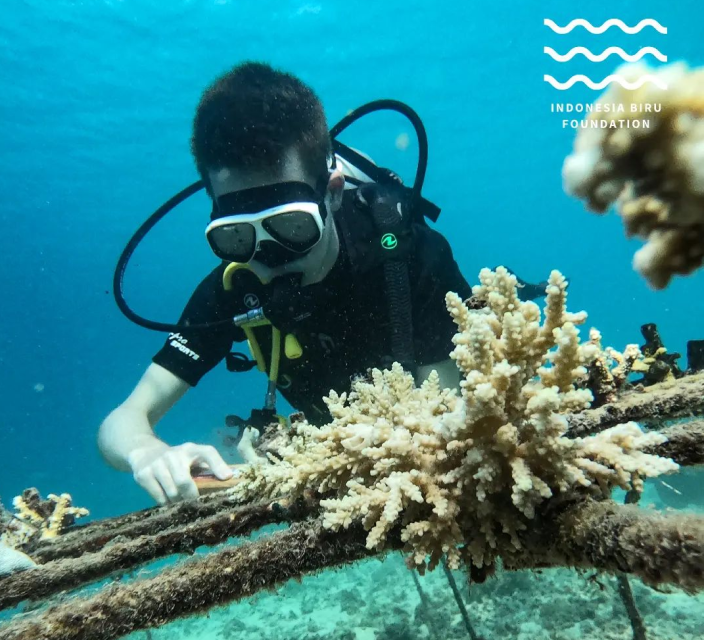
When selecting a restoration site, his team first studies the underwater conditions: whether the area is covered in rubble, whether surveys show a damaged reef that still has “hope,” and whether recovery is realistically possible. They then assess other ecological factors—fish biomass, key invertebrates, and natural processes that could help or hinder the reef’s return.
Practical considerations also matter, such as how easy the site is to access from shore and whether local human activities continue to threaten the area. If those stressors are still active, restoration can’t begin. But once they’re managed, the team can finally step in and start the work.
“Last but not least, we need support from the local people,” Andre added. “Once the community is on board—and ideally becomes part of the team—then we can start working there. That’s exactly what happened in Kecinan, Nipah, and Gili Asahan.”
What Changes, What Doesn’t
Asked whether his work has made an impact, Andre paused before answering, “Yes, partially.”
He explained that among the local communities, especially those actively involved in IBF’s programs, he claims, there has been a noticeable shift. People are beginning to see things they never recognized before. They are starting to connect the dots and understand simple but essential truths: that coral is an animal, not a rock; that it doesn’t grow overnight; that it isn’t like grass. This foundational awareness is slowly taking root, though not universally. “I would say only around 10 to maybe 15 percent of the community,” he admitted.
On the tourism side, Andre said the picture is mixed. “For tourists, it really depends on where they come from and what kind of background they have.” Those who are already scuba divers or surfers tend to arrive with a stronger understanding of marine ecosystems. Many tourism operators—resorts, dive shops, restaurants—are also making an effort to spread awareness, which helps. “Tourists are becoming more educated,” he noted. “But still, I would say the perception has changed only about 20 to 25 percent.”
The gaps remain visible. “I still see tourists holding turtles, tourists stepping on corals,” he said. “There is still a lot more to do. And it’s our responsibility—though not ours alone—to keep educating people.”
Lombok’s coastlines are still under pressure—from plastic, from tourism, from decisions made far from the shore. IBF’s work has not solved these problems, and it was never designed to.
What it has done is insist on presence: local people in local waters, paying attention long enough to notice what is disappearing—and what, against expectation, is not yet gone.
 lombokdispatch.id