
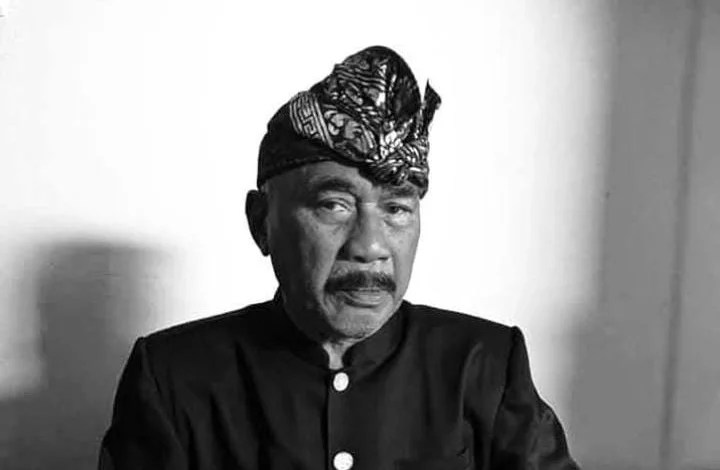
“Create something and you will live forever,” and this is what Lalu Nasib did. Composer. Songwriter. Puppeteer (Dalang). Cultural figure. He will continue to live on. And at the very least, he will live on in my head.
I heard Lalu Nasib’s works at least before I entered elementary school. Of course, back then, I didn’t know that the songs Lalu Nasib produced were his works. I was more familiar with Ahmadi or Agul, the eccentric vocalists who sang his works.
Also, I couldn’t listen to Lalu Nasib’s works as I wished every day. I could only hear them when there was a celebration (hajatan). Usually, during these moments, the musholla‘s loudspeaker would be willingly relinquished from broadcasting the call to prayer or adzan for the sake of a person’s event. Whether it was a wedding, a circumcision, or other events that required many people and needed a loudspeaker to announce something or play music.
And for sure, besides coffee, the sound of music became an added point to attract people to come to the host’s house. Or, it might be too crude to call it a reciprocal gesture of mutual help at the host’s event.
Back then, only certain people owned music players. The music player usually came as a complete package, which included cassettes. Whenever there was a celebration, the music player and those cassettes became items that absolutely had to arrive early.
Music would be played all day, even long after the Isha (evening) prayer; the music would keep playing. Of course, there weren’t many choices back then, so one song could be played up to ten to fifteen times a day.
In the early to mid-2000s, in a small village in Central Lombok, Lalu Nasib was a popular name. An artist, to put it simply. A Maestro. Through Ahmadi or Agul, Lalu Nasib’s works felt like the music that would accompany any celebration taking place.
We, the elementary school kids who were only after the communal meal, could memorize his songs by heart. I’m sure some people must have been bored hearing the same song played repeatedly. However, there was no other choice.
On Friday, August 29, 2025, the popular maestro, H. Lalu Nasib AR, was reported to have passed away. But then, the melancholy arrived. I feel, or for me, Lalu Nasib didn’t receive many awards or recognition. The romanticism and memories of the past compel me to write an ode to him. And perhaps, this short written ode alone is not enough to describe his greatness.
He is widely known as the most senior and famous dalang (puppeteer) across all of Lombok. However, I think his music production is another side of the maestro that is no less important.
His music and songs often became the marker of an era in the Lombok region. The songs he created closely captured the social conditions occurring on the island of a thousand mosques. Songs about migrant workers (TKI) going to Malaysia signified how the government failed to provide equal job opportunities, forcing Lombok people to migrate and become TKI, overseas.
The deeply moving love songs he produced were also numerous and even more popular. Heartbreak, infidelity, unrequited love, endless loyalty—Lalu Nasib seemed to provide an piece for the emotionally distressed people of the two-thousands era.
On the other hand, several songs he created also carried messages of social critique. But there are also songs that still have a male-chauvinist vibes.
I know he sometimes sang his own songs, but more often, it was through his wife, Jamilah, or Ahmadi or Agul, that the works of the man behind the scenes were popularized.
In 2025, I personally don’t know much about the label or the process by which these songs were created. I don’t even know where I can get official releases of these songs. The cassettes we played at those celebrations years ago were certainly pirated as well.
Today, as a result, I can only play and listen to his works through videos on YouTube. And sadly, these videos are certainly pirated too. It feels incredibly unfair when reflecting on this. However, the memory and the recollections, as well as the melancholy and romanticism that Lalu Nasib provided in my childhood, are worthy of the highest appreciation.
And he, H. Lalu Nasib AR, should be more celebrated.
written by nightman
 lombokdispatch.id