
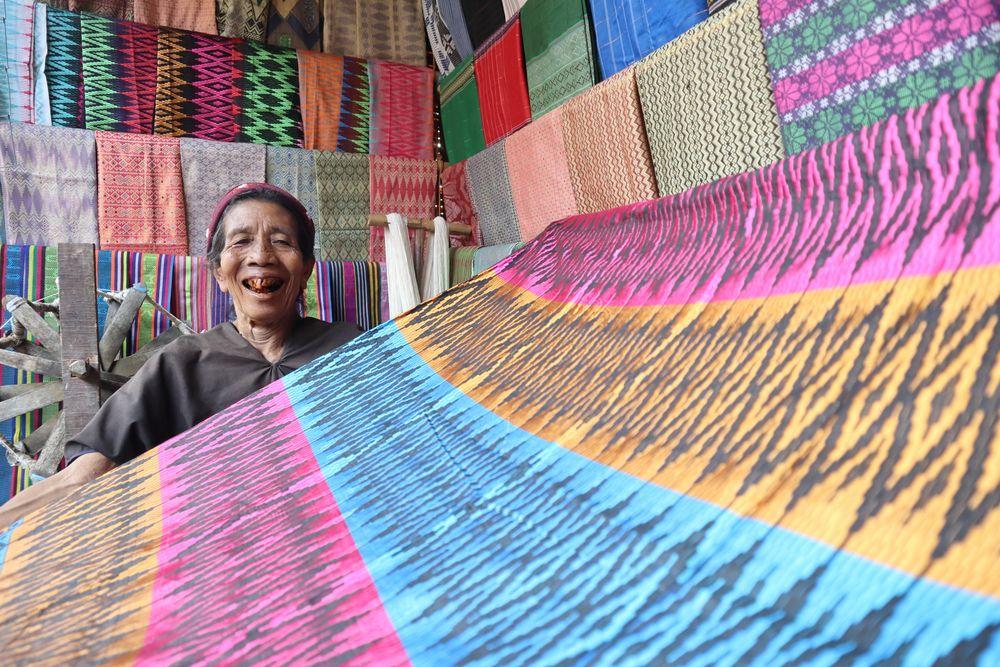
The charm of Lombok’s distinctive woven fabrics, especially Sasak weaving, makes them a must-bring souvenir home when visiting. These items are a must-have gift for special people after visiting Lombok. Not only are they unique, but the woven textiles created by the skilled hands of the Sasak people are also rich in meaning and philosophical values.
In fact, in Sasak tradition, weaving skills are a requirement for marriage for women in Lombok. This means that Sasak women must be able to weave to be able to perform wedding ceremonies. This is a value believed in and cultivated in Lombok. However, over time, this value has faded.
Lombok Women and Weaving Skills
In the Sasak language, weaving is called “tesesek,” which means inserting threads one by one, or “sak sak.” The threads are then tightened by beating the loom to create a complete piece of cloth.
According to The Asian Parent website (https://id.theasianparent.com/kain-tenun-lombok), the weaving skills of the people of Lombok have been passed down through generations since the time of the ancestors of the Sasak people. Each generation is obligated to learn and pass on the weaving skills to their descendants. This is part of the ethnic customs of Lombok, namely the Sasak people.
Sasak people, especially women, are required to learn and master weaving techniques from an early age. In fact, weaving skills are a requirement for women to be eligible for marriage. Sasak customary law stipulates that a Sasak woman must be able to weave at least three pieces of cloth to be eligible for marriage. If she fails to do so, she is deemed unfit to start a family.
Although this rule is no longer so restrictive, Lombok women still practice weaving. Beyond preserving culture, weaving offers numerous benefits.
Beyond its spiritual significance, Lombok woven fabrics also play a vital role in advancing the local economy. It’s evident that woven fabrics are one of the creative economy products always sought after by tourists when visiting Lombok.
Characteristics of Lombok Woven Fabrics
Lombok has two types of traditional fabrics: songket and ikat. These can be distinguished by their colors, motifs, and function. Lombok’s songket woven fabrics are generally more colorful and feature silver or gold accents.
Lombok’s ikat woven fabrics, on the other hand, typically feature simple motifs, consisting of horizontal or vertical lines. Their shapes are also simple, making them more functional. This is in keeping with the Sasak people’s daily use of woven fabrics, such as swaddling babies, blankets, funeral coverings, and prayer items.
The diversity of Lombok woven fabric motifs is largely influenced by the beliefs of the Sasak people. Before the arrival of Islam, Lombok woven fabrics were dominated by depictions of living creatures such as humans, fauna, and flora. They still hold fast to animist beliefs, dynamism, and Hindu teachings.
However, after the arrival of Islam, their decorative motifs became dominated by vine motifs, the tree of life, eight-tiered flowers, and other plant forms. Islamic culture also blended with local culture, resulting in the lotus flower motif in the subhanale motif.
As if defying the times, Lombok’s weavers have maintained their distinctive weaving to this day. They also use traditional and natural tools and materials. It’s no wonder that Lombok’s woven fabrics are considered sustainable and environmentally friendly.
 lombokdispatch.id