
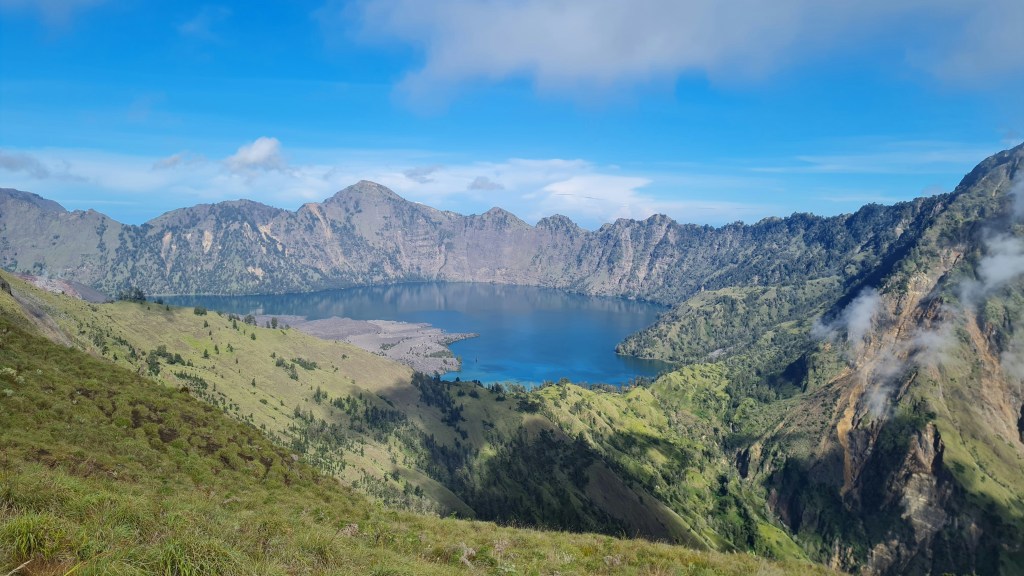
Many people know about Mount Rinjani in Lombok. It’s a very beautiful and tall mountain. But Mount Rinjani actually sits on top of an older, much bigger volcano named Mount Samalas. This ancient giant caused one of the largest and most powerful volcano explosions ever recorded.
The Huge Explosion of 1257
Mount Samalas exploded in the year 1257. This event was so big it changed the weather all over the world. Scientists say it was one of the strongest volcanic blasts in the last 7,000 to 10,000 years.
At first, scientists didn’t know where this huge explosion came from. They found proof of it in ice from the North and South Poles. These ice layers, which hold old air samples, showed a massive rise in sulfur around the year 1257.
It wasn’t until around 2013 that a group of scientists, led by Frank Lavigne, found the real source: Mount Samalas in Lombok. They checked rocks, dated burnt trees, and looked at old local stories.
An Old Lombok Story: The Babad Lombok
A very important clue came from an old book called the Babad Lombok. This book, written on palm leaves, described a terrible volcano eruption that matched the global event. It talked about a massive part of the volcano falling apart, roaring floods of rocks, and villages being destroyed. The old capital city of Pamatan in Lombok was completely wiped out and is still lost today.
The Babad Lombok says that the eruption caused Mount Rinjani to “slide” and Mount Samalas to “collapse.” It describes rock floods that roared down, destroying homes and sweeping them into the sea. Many people died. The book also talks about a terrible earthquake that lasted seven days, making people run to the hills for safety.
Global Effects
The 1257 eruption of Mount Samalas sent huge amounts of ash and sulfur gas high into the sky, about 43 kilometers (around 27 miles) up. This created a thick cloud that blocked sunlight from reaching Earth. This made the world’s temperature drop a lot.
The effects were felt everywhere:
- Colder Weather: The eruption caused a “volcano winter” and made the whole world colder for several years. For example, in 1258, places in the Northern part of the world had a very cold summer with heavy rains. Crops failed in many places, especially in Europe.
- Problems for People: This bad weather is thought to have led to hunger and unrest in many parts of the world, including Europe and Japan. Some old graves found in London, with many people buried together, might be linked to the widespread hunger and deaths during this time.
- How Big It Was: Experts think Samalas shot out over 40 cubic kilometers of material. Its power was thought to be eight times stronger than the Krakatoa explosion in 1883 and twice as strong as the Tambora explosion in 1815.
Samalas and Mount Rinjani: A Shared Past
Today, what’s left of Mount Samalas is the amazing Segara Anak caldera. This is a huge crater lake inside the Mount Rinjani area. Mount Rinjani itself, which is 3,726 meters (12,224 ft) tall, is Indonesia’s second-highest volcano. It now stands tall over Lombok.
The beautiful blue Segara Anak Lake formed directly because Mount Samalas collapsed after its giant eruption. Inside this big hole, new smaller volcanoes have grown over time, like Gunung Barujari. This new cone is still active and is often called “Rinjani’s child.”
So, when you hike Mount Rinjani and see the peaceful Segara Anak lake, you are actually standing inside what’s left of an ancient giant. This old volcano changed Lombok’s history and even the world’s climate. It’s a strong reminder of Lombok’s active past with volcanoes.
 lombokdispatch.id