
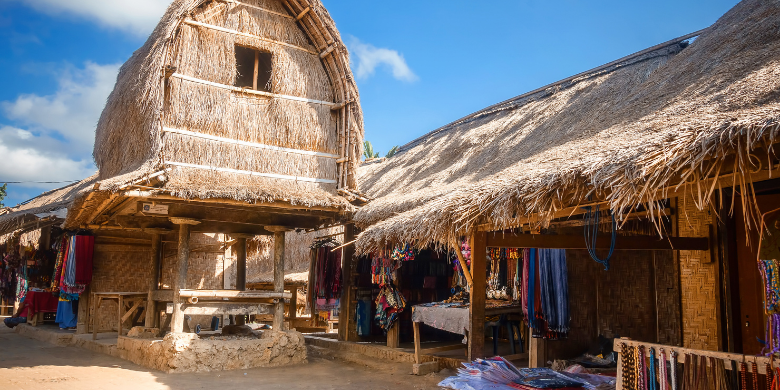
The Sasak are one of the indigenous tribes inhabiting Lombok Island, Indonesia. They have a rich cultural heritage, one of which is the traditional Sasak house, which serves as a symbol of their identity.
The traditional Sasak house on Lombok Island resembles a barn (Rumah Lumbung), which is why it is often referred to as the Sasak barn. Although its shape may appear very simple, the Sasak house possesses aesthetic value and philosophical messages. The barn shape teaches people to live frugally and avoid waste, by always saving their earnings, symbolized by the rice inside the barn.
Parts of a Traditional Sasak House
The Sasak barn has several parts. These parts consist of the roof, rooms, and foundations, each of which has deep meaning.
Roof
The roof of the Sasak barn is shaped like a mountain, sloping down 1.5 to 2 meters from the ground. The roof and ridge (bungus) are made of woven bamboo and have no windows.
Rooms
The rooms (rong) in a traditional Sasak house are divided into three sections: the main room (inan bale), the sleeping area (bale luar), and the bale dalam. The bale dalam is where possessions are stored, where births are given, and where the body is kept before burial.
Foundation
The foundation consists of two parts: the stairs and the floor. The steps, or staircase, connect the bale luar and bale dalam. The steps consist of three steps. The floor is a mixture of straw ash, soil, buffalo or horse dung, and sap. All these materials are mixed and used as the foundation on which the house stands.
Philosophy of the Sasak Traditional House
Building a Sasak Lumbung house must be done according to traditional customs. Islamic teachings underlie the construction of traditional houses. This has profound philosophy and meaning.
Quoted from Kompas.com, three steps represent the stages of human life: birth, development, and death. The three steps also symbolize family members: father, mother, and child. The four supporting pillars symbolize Islamic law, namely the Quran, Hadith, Ijma’, and Qiyas. The direction the house faces indicates the hierarchy of family lineage. The rooms for the eldest and second children are in different directions and locations.
The direction the house faces indicates the hierarchy of family lineage. The rooms for the eldest and second children are in different directions and locations. The parents’ room occupies the highest level, followed by the eldest in the lower room, and so on. The parents’ room faces east, symbolizing that the older generation receives enlightenment before the younger.
The door of the house faces east, or opposite the direction of the setting sun. This means that when they leave their homes to seek a living, their first hope is for the pleasure of Allah SWT. Door frames and doors are made low, so people must bow when entering or exiting the house. This bowing or bowing position is etiquette and a sign of respect from guests to the homeowner.
The Sasak traditional house, with its distinctive characteristics, reflects local wisdom and adaptation to the natural environment. The Sasak people value the sustainability of nature and tradition, making this traditional house an important symbol of their identity.
The construction of a Sasak traditional house is deeply imbued with philosophical meaning and Islamic teachings, as the majority of the Sasak people are Muslim. These traditional houses can now only be found in tourist villages such as Sade Village, Ende Village, and others.
 lombokdispatch.id